
Published: 2 Jul 2026
Transition Facilitation (Quality Control) Order, 2026: A Faster, No-Audit Route to BIS Licensing
Omega QMS Compliance Insights
Omega QMS
Regulatory Update
DPIIT Order — Effective 25 June 2026
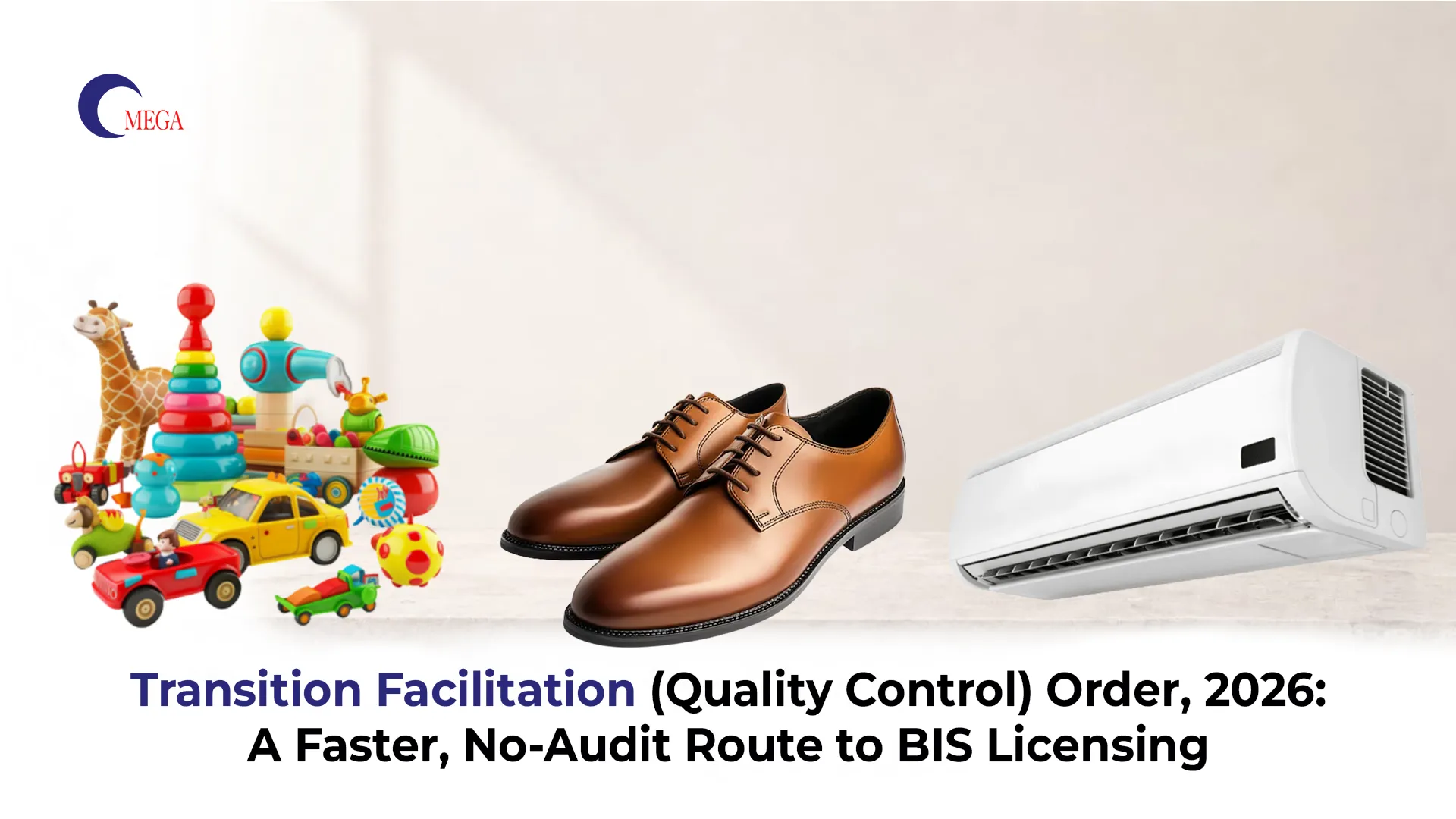
DPIIT has created a facilitation route for goods under 10 specified Quality Control Orders — toys, footwear, air conditioners, water heaters, washing machines, hinges, furniture, and household electrical appliance safety — to obtain BIS licensing faster, cheaper, and without a factory audit of the overseas manufacturer.
The Order
Purpose
Issued by the Department for Promotion of Industry and Internal Trade (DPIIT), Ministry of Commerce and Industry, on 25 June 2026 and effective from the date of Gazette publication, the Transition Facilitation (Quality Control) Order, 2026 creates an alternative, facilitated route for goods covered under 10 specified Quality Control Orders to obtain BIS licensing more easily — without changing the underlying Indian Standards those goods must conform to.
The Mechanism
How the Process Actually Works
Step 1
The Indian company/importer — not the foreign manufacturer — applies to DPIIT for “permission” under this Order
Step 2
The Implementation Committee evaluates the Indian applicant’s risk profile: technical capability, supply chain oversight, compliance history, and commitment to local manufacturing/R&D
Step 3
If the Indian company’s application is approved, its overseas vendor/manufacturer becomes eligible to apply for a BIS licence under Scheme-II of the BIS (Conformity Assessment) Regulations, 2018
Step 4
The licence is issued to the manufacturer — but is valid only for supplying that specific approved Indian company. It is not a general licence.
The Appeal
Why This Route Is Attractive
Speed
Faster than standard BIS licensing
The facilitated route is designed to move quicker than the conventional BIS certification process for these product categories.
Cost
Cheaper for the manufacturer
Lower overall cost of compliance compared to pursuing a standard BIS licence independently.
No Factory Audit
A major departure from normal BIS practice
No physical factory inspection is required for the foreign manufacturer — something the standard BIS certification process typically mandates.
Where the Risk Moves
Vetting shifts to the Indian importer
This effectively shifts the compliance burden and vetting responsibility onto the Indian importer’s credibility — as assessed by the Implementation Committee — rather than requiring BIS to audit each overseas factory individually.
Fine Print
Other Key Provisions
- Eligibility: Applicant must be a company incorporated under the Companies Act, 2013
- Committee: Chaired by Addl./Joint Secretary (DPIIT), with members from Consumer Affairs, Commerce, DGFT, and BIS
- Enforcement: Permission can be suspended, modified, or withdrawn for breach of conditions, misrepresentation, or non-conformity — after a hearing
- Application window: 24 months from commencement of the Order
- Order validity: Remains in force for 5 years
- Survival: Permissions already granted remain valid even if the Order is later rescinded
Schedule
The 10 QCOs Covered by This Facilitation Route
| # | Product | Implementation Date |
|---|---|---|
| 1 | Toys | 01.01.2021 |
| 2 | PPE Footwear | 01.01.2022 |
| 3 | Air Conditioners | 01.10.2023 |
| 4 | Rubber/Polymeric Footwear | 01.08.2024 |
| 5 | Leather Footwear | 01.08.2024 |
| 6 | Water Heaters | 01.03.2025 |
| 7 | Washing Machines | 01.04.2025 |
| 8 | Hinges | 01.07.2025 |
| 9 | Furniture | 13.02.2026 |
| 10 | Household Electrical Appliance Safety | 01.10.2026 |
What It Means for Manufacturers & Importers
A parallel, risk-based pathway to BIS licensing exists for these 10 product categories — alongside, not instead of, the standard licensing route.
Faster, cheaper market access for overseas manufacturers — but tied exclusively to one Indian buyer, limiting flexibility to diversify customers under that licence.
The Indian importer’s credibility becomes the gatekeeping asset — a strong compliance track record and technical capability materially improve approval odds.
How Omega QMS Can Help
Support for Indian Importers & Overseas Manufacturers
- Assessing eligibility for the Transition Facilitation route against your product category
- Preparing the Indian applicant’s DPIIT permission application and risk-profile documentation
- Building the technical capability and compliance-history case for the Implementation Committee
- Coordinating with the overseas manufacturer on the Scheme-II BIS licence application
- Advising on when the standard BIS route may still be preferable to this restricted, single-buyer licence
- Ongoing advisory on QCO compliance across all 10 covered product categories
Key Insight
This Order doesn’t lower the bar on product conformity — goods still have to meet the same Indian Standards. What it changes is who gets audited: instead of BIS vetting every overseas factory, the Indian importer’s own credibility becomes the gate. That makes this route attractive, but also narrow — the resulting licence only ever serves the one Indian company that sponsored it.
Considering the Transition Facilitation route for your product?
Omega QMS helps Indian importers build a strong DPIIT permission application and helps overseas manufacturers navigate the Scheme-II BIS licensing process under this Order. Talk to our regulatory team about whether this route fits your situation.
Reference
Transition Facilitation (Quality Control) Order, 2026, issued by the Department for Promotion of Industry and Internal Trade, Ministry of Commerce and Industry, Government of India, dated 25 June 2026, in exercise of powers under section 16 read with sub-section (3) of section 25 of the Bureau of Indian Standards Act, 2016. Effective from the date of publication in the Official Gazette.