
Published: 12 May 2026
A Single Gazette Notification, A Thousand Supply Chain Decisions
Omega QMS Compliance Insights
Omega QMS
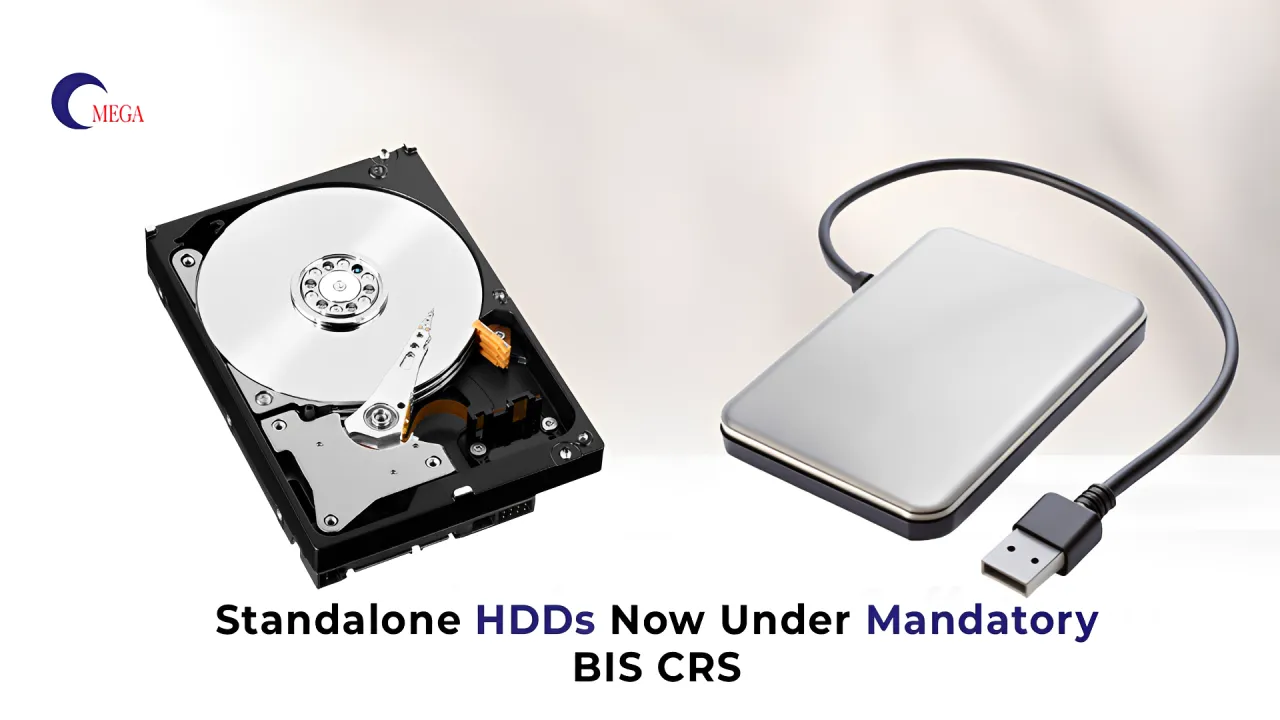
What S.O. 2204(E) on Hard Disk Drives, updated with the latest QCO landscape, HDD import dynamics and Make in India imperatives, tells us about how India’s regulatory architecture is maturing.
At a Glance: What Changed
Definitional Precision Over Broad Strokes
On 5 May 2026, the Ministry of Electronics and Information Technology issued S.O. 2204(E), amending the Electronics and Information Technology Goods (Compulsory Registration) Order, 2021. The product description at S. No. 50 of the CRS Schedule has been revised from the broader “Hard Disk Drives” to the precise “Standalone Hard Disk Drives”. A compliance deadline of 5 November 2026 has been set for all standalone HDDs that are not USB Type external drives.
“Hard Disk Drives”
- Ambiguous at customs
- Compliance boundary unclear for bare drives, NAS units and internal drives
- Risk of grey-zone non-compliance
“Standalone Hard Disk Drives”
- USB Type external HDDs ring-fenced separately
- Zero definitional ambiguity
- Clear certificate boundary for importers
USB Type External HDDs
Covered under prior CRS provisions. Existing R-number holders need no fresh action.
All Other Standalone HDDs
Internal, NAS, bare and non-USB external drives require a fresh BIS CRS R-number before 5 November 2026.
Why This Matters Now: HDD Import Dynamics
India’s dependence on imported standalone HDDs is substantial and structurally entrenched. The dominant supply base is offshore: Thailand, Malaysia, China and Singapore together account for the majority of shipment volumes. Between July 2024 and June 2025, over 2,800 documented shipments of computer hard disks entered India, facilitated by more than 528 exporters globally.
The supply oligopoly (Seagate, Western Digital and Toshiba collectively control more than 95% of global HDD shipments) means India’s import exposure is concentrated and price-sensitive. Any compliance disruption at the border has downstream consequences for data centres, surveillance networks, NAS deployments and consumer storage alike.
India’s retail HDD volumes expanded 12% quarter-over-quarter in Q2 2024, driven by e-commerce penetration, home-office infrastructure growth and smart city surveillance budgets. Demand is rising even though SSD prices fell about 24% between 2023 and 2025, because HDDs keep a decisive cost-per-terabyte advantage for archival, NAS and surveillance applications.
Top Source Countries by Shipment Share
- China: 20% of global export shipments
- Thailand: 20%, Western Digital manufacturing hub
- Singapore: 15%, re-export and distribution hub
- Malaysia: significant secondary supplier
India HDD Demand Drivers
- Data centre and cloud storage build-outs
- Smart city surveillance, including CCTV and NVR systems
- NAS deployments for SME and enterprise
- Consumer external storage and home backup
Supply Concentration Risk
Seagate, Western Digital and Toshiba control over 95% of global HDD output, with Thailand and Malaysia the principal manufacturing geographies. Any disruption at source propagates directly into India’s import pipeline, which strengthens the strategic case for domestic manufacturing capability.
CRS Is One Layer of a Multi-Tier System
S.O. 2204(E) operates within a larger regulatory framework than a single notification suggests. India’s electronics quality governance has two primary tracks: the Compulsory Registration Scheme (CRS, or Scheme II under BIS) and the Quality Control Orders (QCOs) issued under the BIS Act, 2016. They are complementary, not competing.
- Administered by MeitY for electronics and IT goods
- Covers 70+ product categories since 2012
- Lab testing required; no mandatory factory audit
- Self-declaration after BIS-recognized lab testing
- R-number issued upon compliance
- HDDs now precisely defined under S. No. 50
- Issued under Section 16 of the BIS Act, 2016
- 187+ active QCOs as of March 2025 covering 679+ categories
- Factory audit mandatory under Scheme I / ISI Mark
- Covers metals, machinery, electronics, textiles and chemicals
- Foreign manufacturers need an Authorized Indian Representative (AIR)
- Expanding rapidly since 2020
Since 2020, QCOs have expanded dramatically. The Machinery and Electrical Equipment Safety (Omnibus Technical Regulation) Order, 2024 became mandatory from 28 August 2025, covering a sweeping range of switchgear and machinery under Scheme X. The Safety of Household, Commercial and Similar Electrical Appliances (Quality Control) Order, 2026, superseding the 2025 version, comes into force on 1 October 2026 under IS 302 (Part 1): 2024, aligned with IEC 60335-1:2020.
VR, AR and Mixed Reality headsets have been brought under mandatory CRS registration under MeitY notifications. Digital Television Receivers with built-in satellite tuners received a compliance extension to July 2026. The furniture and chemicals sectors also saw QCO activity in Q1 2026, with the Furniture (Quality Control) Order, 2025 enforcement beginning mid-February 2026.
CRS (Scheme II) for electronics does not require a factory audit, so the HDD R-number pathway is faster than most QCO (Scheme I) routes. Even so, documentation, lab testing at IS 13252 facilities and application processing run 12–24 weeks end to end, making immediate initiation critical ahead of 5 November 2026.
How Mandatory Compliance Creates Domestic Manufacturing Pull
The intersection of S.O. 2204(E), the broader QCO architecture and India’s PLI and Make in India frameworks reveals an industrial policy logic that goes beyond consumer protection. Mandatory compliance requirements are not a constraint layered on top of manufacturing ambition. They are an enforcement mechanism that makes it credible and investable.
Every QCO or CRS entry creates a verified quality floor for imported goods. When an importer must obtain an R-number or ISI mark, and demonstrate lab-tested conformance, factory audits and ongoing surveillance compliance, the cost and friction of importing substandard goods rises significantly. That friction changes the investment calculus for global OEMs and Indian manufacturers alike.
India’s electronics import bill of roughly $75–80 billion a year includes many products that could be made domestically with the right incentives and supply chain infrastructure. The PLI scheme for IT Hardware, the Make in India push and the Atmanirbhar Bharat vision are demand-side ambitions. CRS and QCO compliance requirements are the supply-side discipline that forces investment.
Compliance Cost Creates a Level Playing Field
An importer of a low-cost, untested HDD from a non-certified facility faces the same compliance requirement as an established OEM, eliminating the price arbitrage that substandard supply chains exploit.
R-Number as Market Access Credential
For any HDD sold, distributed or imported into India after 5 November 2026, the R-number is the entry ticket. Manufacturers with domestic assembly or testing operations gain proximity to BIS labs, reduced logistics friction and faster audit scheduling.
Factory Audit Incentive for Local Setup
CRS (Scheme II) does not mandate a factory audit, but QCO (Scheme I) routes do. As QCO coverage expands into storage and peripherals, the advantage of a domestic manufacturing or assembly footprint grows.
PLI Alignment
The IT Hardware PLI scheme covers laptops, tablets and servers, all significant HDD consumers. A domestic HDD manufacturing or assembly ecosystem reduces PLI beneficiaries’ import dependency and strengthens the electronics value chain.
QCOs and CRS compliance requirements create the market discipline that forces investment. Every new CRS entry or QCO notification is a building block in India’s long-term electronics manufacturing self-reliance, not a compliance burden.
Stopping Substandard HDD Imports
Beyond manufacturing ambition, the definitional precision of S.O. 2204(E) serves a direct consumer protection function. India’s HDD import channel has historically included a segment of unverified, untested storage devices, particularly in the sub-₹2,000 external drive and bare drive segments, that carry no traceable quality certification.
Data Integrity Failure
Uncertified HDDs frequently use platters, read-write heads and spindle motors not tested for sustained reliability. For SMEs relying on NAS and direct-attached storage for business-critical data, this is material operational risk.
Electrical Safety Hazard
IS 13252: Part 1: 2010, the applicable CRS standard, is harmonised with IEC 60950-1, the global benchmark for IT equipment safety. Uncertified drives skip this testing, creating fire risk, power surge vulnerability and compatibility failures.
Surveillance System Reliability
India’s smart city and private surveillance build-out needs 24×7 write-intensive operation. Drives not tested for this use case fail early, creating security gaps in critical infrastructure.
No Traceability or Accountability
An R-number creates a direct accountability chain: the importer or manufacturer holds legal responsibility for conformance under the BIS Act. Without one, there is no enforcement mechanism and no recourse for the buyer.
- No IS 13252 safety testing
- No BIS-recognized lab validation
- No factory audit or quality surveillance
- No importer accountability under the BIS Act
- No enforcement mechanism at customs
- IS 13252 / IEC 60950-1 safety validated
- BIS-recognized lab test report mandatory
- Ongoing BIS surveillance compliance
- Importer/manufacturer legally accountable
- Customs cross-check against amended CRS schedule
The six-month compliance window, 5 May to 5 November 2026, is a calibrated regulatory pressure point. It is long enough to be reasonable for compliant participants, and short enough to force immediate action from importers who exploited the ambiguity of the old “hard disk drives” description. After 5 November, non-registered standalone HDDs face import disruption.
What S.O. 2204(E) Tells Us About India’s Regulatory Trajectory
The CRS has operated since 2012. In its early years, broad product descriptions were a pragmatic choice: establish the compliance principle while regulatory experience accumulated. That meant observing how markets classify, import and deploy products, how descriptions translate into Bills of Entry at customs, how factory audit scopes are contested, and how litigation risk develops when certificate boundaries are ambiguous.
S.O. 2204(E) is evidence that this accumulation has occurred. Replacing “hard disk drives” with “Standalone Hard Disk Drives” and preserving the USB Type external HDD provisions separately is precision refinement that removes grey zones creating compliance risk, enforcement inconsistency and supply chain anxiety. It is evidence-based refinement of an existing framework, not a sweeping new mandate. The parallel growth of QCO coverage, from 187 active QCOs covering 679+ product categories as of March 2025, ten times the 2016 figure, shows the same systematic ambition.
S.O. 2204(E) is one data point in a consistent trajectory. Since 2020, India has progressively expanded both CRS scope and the parallel QCO architecture. The direction is unambiguous: India’s compliance architecture will continue to deepen, sharpen and extend. Building internal compliance capability is a strategic investment in uninterrupted market access, not a reactive cost.
For Supply Chain and Compliance Leaders
For procurement managers, import compliance teams and supply chain leaders in India’s electronics sector, S.O. 2204(E) generates five immediate action requirements:
| # | Action | Detail |
|---|---|---|
| 1 | Audit Existing R-Numbers | If your CRS portfolio holds an R-number issued under the prior broader “hard disk drives” description, confirm with a BIS compliance expert whether it covers “Standalone Hard Disk Drives” as now defined. Do not assume. Customs officers cross-checking certificates against the amended schedule will look for this alignment. |
| 2 | Initiate Registration Now | The BIS CRS timeline totals 12–24 weeks: document preparation 1–2 weeks; BIS application 1 week; sample testing at an IS 13252 lab 4–8 weeks; application review and query resolution 4–10 weeks; R-number issuance 2–3 weeks. Starting in Q3 2026 risks non-issuance before 5 November 2026. |
| 3 | Map Full HDD Portfolio | Enumerate every standalone HDD SKU imported or sold in India: internal drives, bare drives, NAS drives and non-USB external drives. Each variant may need its own R-number. USB Type external HDDs covered under prior CRS provisions are exempt from fresh registration. |
| 4 | Monitor QCO Pipeline | The 2026 QCO calendar includes major enforcement dates: Household Appliances QCO on 1 October 2026, VR/AR/MR headsets CRS registration, and the Digital TV Receiver deadline estimated in July 2026. Build a standing QCO monitoring function; the compliance calendar will only grow. |
| 5 | Invest in Compliance Infrastructure | India’s electronics compliance architecture will keep deepening. Retaining experienced BIS compliance advisory support and building internal capability is a strategic investment in uninterrupted market access, not a reactive cost centre. |
Compliance Is Market Access
Consider S.O. 2204(E) not as a bureaucratic update to a product list, but as an institution, MeitY working through the BIS regulatory framework, demonstrating evidence-based, precision regulatory refinement. It marks the transition from a young compliance regime to a mature one.
India’s electronics quality governance is past its formative phase. It is consolidating systematically: closing definitional gaps, expanding category coverage, harmonising with international standards and using compliance deadlines as industrial policy instruments. For HDD importers, manufacturers and supply chain leaders, the message is simple: the R-number is not a bureaucratic box to tick. It is market access. From 5 November 2026, it is non-negotiable for all standalone hard disk drives entering India’s market.
The CRS and QCO architecture is the enforcement mechanism that makes PLI, Make in India and Atmanirbhar Bharat credible, and that keeps substandard imports from reaching India’s consumers, enterprises and critical infrastructure.
Selling or Importing Standalone HDDs in India?
Check whether your R-number covers “Standalone Hard Disk Drives” and start BIS CRS registration before 5 November 2026.
Source: S.O. 2204(E), MeitY, 5 May 2026. Electronics & IT Goods (Compulsory Registration) Order 2021 (Amended). BIS Act 2016. QCO landscape data as of May 2026. HDD import data: Volza Trade Intelligence, Jul 2024–Jun 2025. Market data: Mordor Intelligence, Research & Markets, 2025–2026.
Disclaimer: This document is for informational purposes only and does not constitute legal or regulatory advice.