
Published: 6 Jul 2026
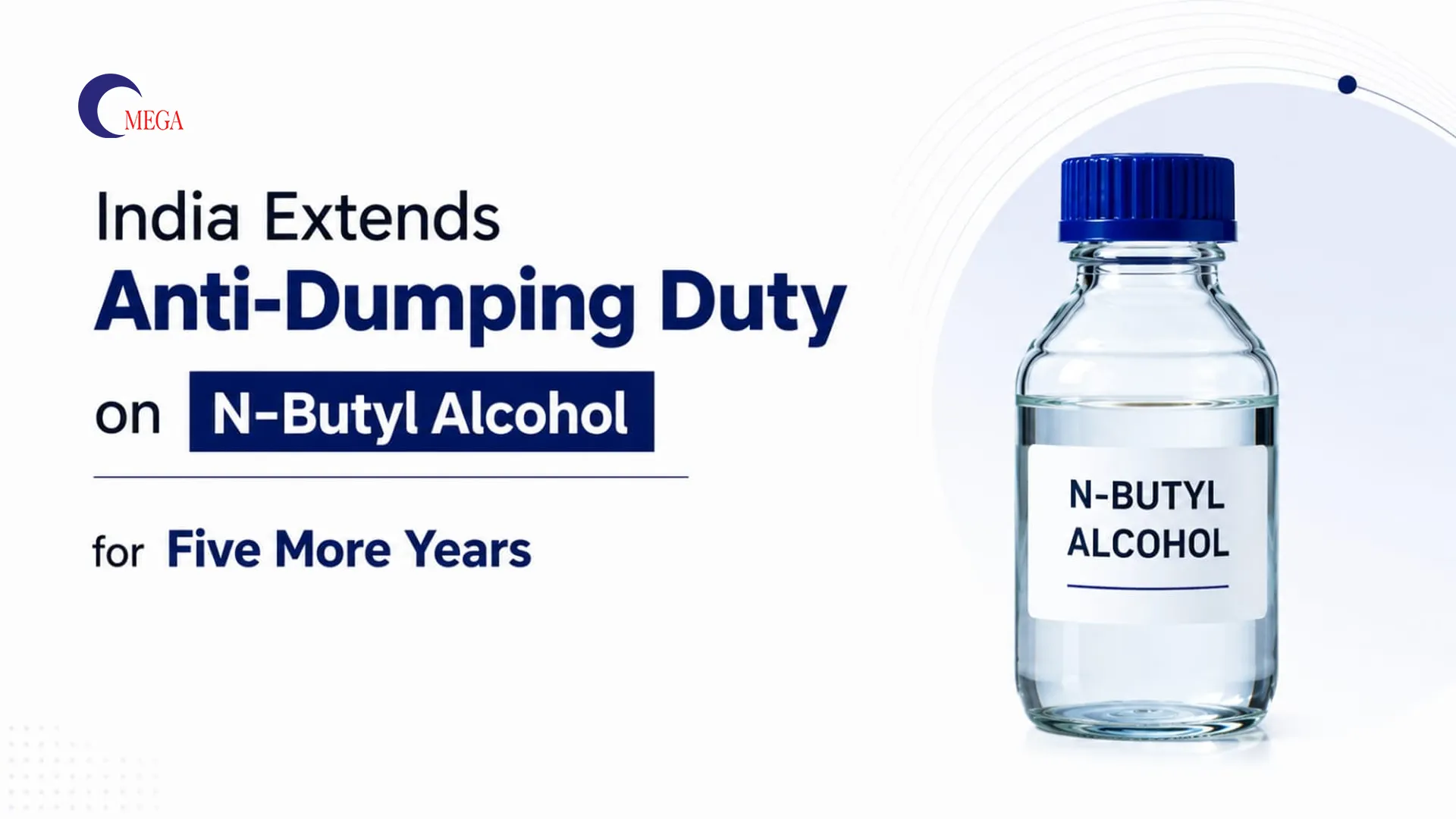
India Extends Anti-Dumping Duty on N-Butyl Alcohol from Malaysia, South Africa and the USA for Five More Years
Omega QMS Compliance Insights
Omega QMS
Omega QMS | Regulatory Intelligence
Regulatory Update | Customs Notification No. 15/2026-Customs (ADD) — Effective 3 July 2026
The Ministry of Finance has continued anti-dumping duty on Normal Butanol(N-Butyl Alcohol) imports from Malaysia, South Africa and the United States for a further five years, acting on the DGTR’s sunset review finding that withdrawing the duty would likely trigger a fresh wave of dumped imports and renewed injury to Indian producers.
THE NOTIFICATION
What Has Been Announced
The Ministry of Finance (Department of Revenue) issued Notification No. 15/2026-Customs (ADD) on 3 July 2026, extending anti-dumping duty on imports of Normal Butanol, also traded as N-Butyl Alcohol, falling under tariff item 2905 13 00 of the Customs Tariff Act, 1975. The customs classification is indicative only and does not limit the scope of the subject goods.
The notification supersedes the earlier levy imposed under Notification No. 21/2021-Customs (ADD) dated 12 April 2021, keeping the protection in place without a break. The new duty runs for five years from the date of Gazette publication, unless revoked, superseded, or amended earlier, and is payable in Indian currency.
N-Butanol is a workhorse industrial solvent and chemical intermediate, feeding into paints and coatings, butyl acrylate, butyl acetate, plasticizers, and pharmaceutical applications. Its pricing directly shapes input costs across India’s coatings and specialty chemicals value chain.
THE BASIS
Why the Duty Was Extended
The Directorate General of Trade Remedies (DGTR) conducted a sunset review and published its final findings on 9 April 2026 (Notification No. 7/16/2025-DGTR). Its conclusion was clear: there is a likelihood of continuation or recurrence of dumping and injury to the domestic industry if the existing anti-dumping duty is allowed to lapse.
On that recommendation, the Central Government exercised its powers under sub-sections (1) and (5) of Section 9A of the Customs Tariff Act, read with Rules 18, 20, and 23 of the Anti-Dumping Rules, 1995, to continue the levy. The stated objective is to maintain a level playing field for domestic manufacturers against artificially low-priced overseas shipments.
THE RATES
Duty Structure at a Glance
The duty is producer-specific for Malaysia and country-wide for South Africa and the USA. All rates are in US$ per metric tonne (MT).
| S. No. | Country of Origin | Country of Export | Producer | Duty (US$/MT) |
|---|---|---|---|---|
| 1 | Malaysia | Any country including Malaysia | BASF Petronas Chemicals Sdn. Bhd. | 26.59 |
| 2 | Malaysia | Any country including Malaysia | PETRONAS Chemicals Derivatives Sdn. Bhd. | 51.42 |
| 3 | Malaysia | Any country including Malaysia | Any other producer | 149.31 |
| 4 | Any country other than the three subject countries | Malaysia | Any | 149.31 |
| 5 | South Africa | Any country including South Africa | Any | 13.24 |
| 6 | Any country other than the three subject countries | South Africa | Any | 13.24 |
| 7 | United States of America | Any country including USA | Any | 24.16 |
| 8 | Any country other than the three subject countries | United States of America | Any | 24.16 |
The rate spread within Malaysia is significant. A named-producer consignment from BASF Petronas Chemicals Sdn. Bhd. attracts a duty of US$26.59/MT, while an unnamed Malaysian producer faces US$149.31/MT, more than five times higher. Origin and producer documentation therefore carry direct financial consequences.
FINE PRINT
The Invoice Declaration Condition
The concessional producer-specific rates for the two named Malaysian producers apply only if the commercial invoice presented to customs carries a signed and dated declaration by an official of the issuing entity, identified by name and function, certifying that the goods covered by the invoice were manufactured by that company in that country and that the invoice information is complete and correct.
If no such invoice is presented, the residual duty applicable to all other producers applies. For Malaysian-origin goods, this means a duty of US$149.31/MT instead of the named-producer rate. Customs authorities also retain full powers of independent verification under the applicable customs laws.
Other Key Provisions
- Duration: Five years from the date of Gazette publication, unless revoked, superseded, or amended earlier.
- Currency: Duty is payable in Indian Rupees (INR).
- Exchange Rate: As notified by the Ministry of Finance under Section 14 of the Customs Act, 1962. The relevant date is the date of presentation of the Bill of Entry under Section 46.
- Anti-circumvention Coverage: Goods originating in third countries but exported through Malaysia, South Africa, or the USA also attract the applicable duty, thereby closing the trans-shipment route.
WHAT IT MEANS FOR IMPORTERS & DOMESTIC INDUSTRY
Importers sourcing N-Butanol from the three subject countries face a continued duty cost for five more years. Landed-cost models, supplier contracts and pass-through pricing built around a possible 2026 lapse of the 2021 duty now need revisiting.
For Malaysian material, the producer declaration on the commercial invoice is the difference between US$26.59 and US$149.31 per tonne. Import documentation discipline is now a direct P&L item.
Domestic producers gain five years of pricing headroom. Downstream users of butanol, in coatings, acrylates and plasticizers, may evaluate alternative origins outside the subject countries, keeping in mind that trans-shipment through the subject countries offers no escape from the levy.
HOW OMEGA QMS CAN HELP
Support for Importers, Traders & Downstream Manufacturers
- Mapping your supply chain exposure to the extended duty across origin, export country and producer combinations
- Reviewing commercial invoice and declaration formats so named-producer consignments actually secure the concessional rate
- Landed-cost and duty impact assessment for existing and planned N-Butanol contracts
- Advisory on alternative sourcing strategies and the anti-circumvention provisions covering trans-shipped goods
- Assistance with bill of entry classification, exchange rate application and customs queries on subject goods
- Monitoring DGTR reviews, amendments and related trade remedy actions across your product portfolio
Key Insight
Sunset reviews rarely make headlines, but they decide whether five-year duties quietly die or quietly continue. Here, DGTR concluded the threat of renewed dumping had not gone away, and the Finance Ministry moved before the 2021 duty could lapse. For importers, the real action sits in the table and the invoice note. The same tonne of Malaysian butanol can cost US$26.59 or US$149.31 in duty depending entirely on whose name is on the invoice and how the declaration is drafted.
Importing N-Butanol or other chemicals under trade remedy measures?
Omega QMS helps importers and manufacturers assess duty exposure, get producer declarations right, and build sourcing strategies that survive DGTR scrutiny. Talk to our trade compliance team about how this extension affects your consignments.
Reference
Notification No. 15/2026-Customs (ADD), Ministry of Finance (Department of Revenue), Government of India, dated 3 July 2026, issued under sub-sections (1) and (5) of Section 9A of the Customs Tariff Act, 1975 read with Rules 18, 20 and 23 of the Customs Tariff (Identification, Assessment and Collection of Anti-dumping Duty on Dumped Articles and for Determination of Injury) Rules, 1995, in supersession of Notification No. 21/2021-Customs (ADD) dated 12 April 2021. Based on DGTR final findings No. 7/16/2025-DGTR dated 9 April 2026. Additional reporting: Economic Times, 4 July 2026.