
Published: 6 Jun 2026
IS 6603:2024 — BIS Certification for Stainless Steel Semi-Finished Products, Bars, Wire Rods & Bright Bars
Omega QMS Compliance Insights
Omega QMS
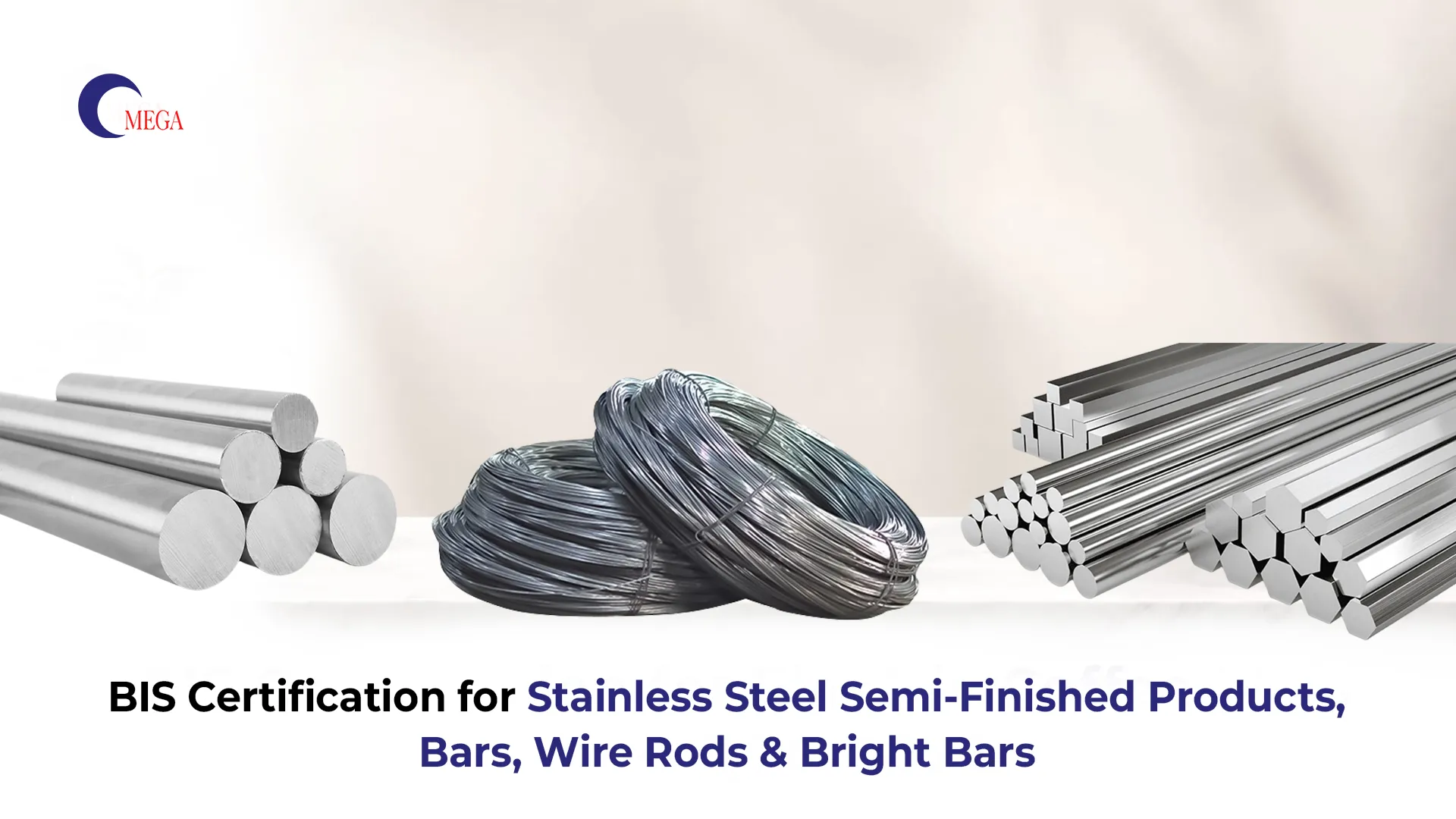
With BIS releasing IS 6603:2024 as the second revision of India’s stainless steel long products specification, manufacturers and importers supplying the Indian market now face updated certification benchmarks. This guide covers every dimension of BIS certification under this standard.
About the Standard
What is IS 6603:2024?
IS 6603:2024 is an Indian Standard published by the Bureau of Indian Standards (BIS) in April 2024 under ICS 77.140.20. It supersedes both IS 6603:2001 (Stainless Steel Bars and Flats) and IS 6527:1995 (Stainless Steel Wire Rod), consolidating coverage into a single, modernised document.
The standard specifies technical delivery conditions for semi-finished products, hot-formed and cold-finished bars, wire rods, and bright bars in various corrosion-resisting stainless steel grades. BIS drew assistance from ISO 16143 (Part 2):2014 and ISO 16143 (Part 4):2023, aligning India’s requirements with current international practices.
Regulatory Context
Why BIS Certification is Mandatory
Under the Steel and Steel Products (Quality Control) Order, the Ministry of Steel has progressively brought stainless steel long products within the mandatory BIS certification framework. Manufacturers, importers, and suppliers must hold a valid BIS licence — bearing the ISI Mark — before placing certified product on the Indian market.
Non-compliance carries serious consequences: products without the Standard Mark cannot be sold, and violations attract action under the Bureau of Indian Standards Act, 2016. As IS 6603:2024 supersedes the 2001 edition, licence-holders operating under the older standard must align with the updated requirements.
Key Updates
Major Changes in the 2024 Revision
Expanded scope
The scope now explicitly includes semi-finished products (blooms, billets from continuous casting or ingot rolling), wire rods, and bright bars alongside the bars and flats covered by the earlier edition.
Revised grade portfolio
Several grades have been added, removed, or redesignated — including the removal of X07Cr18Ni9 and X10Cr17Mn6Ni4N, redesignation of X07Cr17 → X04Cr17 and X12Cr12 → X12Cr13, and new duplex and high-alloy austenitic grades to reflect current market demand.
Surface finish and dimensional tolerances
Process routes and surface finish codes (1U, 1C, 1E, 1D, 1G, 1P, 2H, 2D, 2B, 2G, 2P) are now formally defined in Table 1. Dimensional tolerances for special finishes extend to nominal sizes up to 3,150 mm via IT tolerance grades specified in Table 36.
Freedom from defects criteria
Maximum permissible depths of acceptable discontinuities have been updated (Table 2) with distinct limits by finish condition and product form — grades 1G/2B/2G/2P rounds must be technically defect-free by manufacture.
Product Scope
Steel Families Covered by IS 6603:2024
Austenitic steels
301, 303, 304, 304L, 316, 316L, 310, 310L…
Austenitic-ferritic / Duplex
2101, 2205, 2304, 2507, 2441, 2760…
Ferritic steels
409Nb, 410S, 430, 430F, 434, 439…
Martensitic steels
410, 416, 420, 420B, 431, 440C…
Precipitation-hardening
630, X07Cr17Ni7Al
Super-duplex & high-alloy
2507, 2760, 312, 345, 326…
Technical Requirements
What BIS Evaluates for Certification
Chemical Composition
Table 3 prescribes ladle analysis limits for 70+ steel designations. Product analysis may deviate within tolerances of Table 4. IS 228 methods apply; referee disputes resolved by IS 228.
Mechanical Properties
Proof strength (Rp0.2 & Rp1.0), tensile strength, elongation, and impact energy specified in Tables 5–19 by steel family and size band. Testing per IS 1608, IS 1757, and IS 1500.
Dimensional Tolerances
Annex C (Tables 26–36) details permissible size variations for hot-rolled bars, hexagon bars, flats, cold-finished products, wire rods, and length tolerances up to 3,150 mm.
Surface Quality & Internal Soundness
Acceptable discontinuity depths defined in Table 2 by condition and product form. Internal soundness subject to agreement at enquiry and order stage.
Corrosion Resistance
Where required, inter-granular corrosion resistance verified per IS 10461 (Part 1) or ISO 3651 (Part 2) in both delivery and sensitised conditions, for most austenitic, duplex, and ferritic grades.
Elevated-Temperature Properties
Tables 10–14 provide 0.2% and 1% proof strength at 100–550 °C for guidance. Not mandatory for BIS certification unless agreed between purchaser and supplier.
Application Process
The BIS Certification Process — Step by Step
Application on BIS portal
Submit Form V on biscertportal.bis.gov.in specifying steel grades, product forms, and finish conditions. Attach factory details, floor plan, and proposed scope of production.
Drawing of samples
BIS officers visit the factory to draw samples per IS 3711 covering mechanical test pieces, product analysis samples, and surface inspection.
Testing at BIS-recognised laboratory
Samples tested for chemical composition, mechanical properties (tensile, hardness, impact), dimensional tolerances, and corrosion resistance. Test reports must reference applicable clauses of IS 6603:2024.
Factory inspection
BIS audits manufacturing premises for process capability, calibrated equipment, raw material traceability, heat treatment records, and an in-house QMS ensuring ongoing conformance.
Grant of licence (CM/L number)
On satisfactory testing and inspection, BIS grants a licence specifying permitted scope. Licensee is authorised to apply the ISI Mark along with the licence number and IS number.
Ongoing surveillance
Periodic BIS visits and market sampling. Licence holders must maintain test records and cooperate on corrective actions. Licences are renewable and subject to cancellation for non-compliance.
Marking Requirements
Identification Under Clause 15
Each bar or flat over 50 mm in diameter must be legibly stamped, stencilled, or labelled with the cast number and type of steel. Bars and flats up to 50 mm must be bundled with a tag bearing the cast number and steel type. Each coil of wire rod must carry the manufacturer’s name or trade mark, cast number, and steel designation.
For BIS-certified product, the ISI Mark (BIS logo with IS number and CM/L licence number) must appear on each bundle tag, coil tag, or on the bar itself. The marking method must be durable enough to remain legible through storage and transport.
Omega QMS Role
End-to-End Support for IS 6603:2024 Certification
- Gap analysis against IS 6603:2024 requirements
- QMS documentation — quality manual, SOPs, test plans per IS 8910
- Heat treatment procedure qualification support (Annex A guidelines)
- NABL-accredited laboratory selection & test coordination
- BIS application preparation, portal filing, and BIS liaison
- Pre-audit factory readiness review
- Corrective action support following BIS inspection
- Licence renewal and ongoing annual compliance maintenance
Impact
Full alignment with updated IS 6603:2024 and the Steel & Steel Products QCO notifications, including the latest S.O. 5134(E) amendments.
ISI-marked product cleared for sale and import in India. Importers using FMCS licensing enabled to compete in the market without disruption.
A documented quality system capable of sustaining BIS surveillance visits and market sampling over the lifetime of the licence.
Frequently Asked Questions
Common Questions on IS 6603:2024 Certification
Does IS 6603:2024 apply to importers as well as domestic manufacturers?
Yes. Under the QCO framework, imported stainless steel long products within the scope of the relevant QCO notification must also conform to IS 6603:2024 and bear the BIS Standard Mark. Importers must obtain a BIS licence under the Foreign Manufacturer Certification Scheme (FMCS) or use a licensed Indian importer.
My plant is currently licensed under IS 6603:2001. Do I need to reapply?
Existing licences need to be upgraded to IS 6603:2024 within the transition period notified by BIS. This typically involves submitting revised scope documentation, demonstrating that testing and inspection meet the updated requirements, and potentially undergoing a fresh inspection. Omega QMS can manage this upgrade process on your behalf.
Which grades require corrosion testing and how frequently?
Tables 5 and 6 of IS 6603:2024 indicate whether corrosion resistance testing is required in delivery condition and sensitised condition for each grade. For standard austenitic grades such as 304 and 316 families, resistance in delivery condition is required; sensitised condition testing depends on the grade’s susceptibility. Testing frequency for surveillance follows BIS licence conditions.
Is elevated-temperature data required for initial certification?
Tables 10–14 carry the note that these values are “for the purpose of guidance only” (Clause 9.2). They do not form mandatory testing requirements for BIS certification unless specifically agreed between purchaser and supplier. Initial certification test plans should focus on room-temperature mechanical properties (Tables 5–9 and 15–19).
What documentation does BIS require from a forge or rolled-bar supplier?
Core documents include: ladle analysis certificates (heat certificates), product analysis test reports, mechanical test reports (tensile, hardness, impact), dimensional inspection records, heat treatment records (quench and temper, solution annealing per Annex A), surface inspection records, and — where required — corrosion test reports. All records must reference cast/heat numbers enabling full traceability.
Start Your IS 6603:2024 Certification Journey
Omega QMS provides end-to-end BIS certification support for stainless steel manufacturers and importers — from gap analysis and QMS documentation through to licence grant and ongoing surveillance compliance. Our consultants maintain working knowledge of current QCO notifications and BIS inspection requirements for stainless steel long products.
Contact us at info@globalomega.com or visit globalomega.com/contact to discuss your certification requirements.