
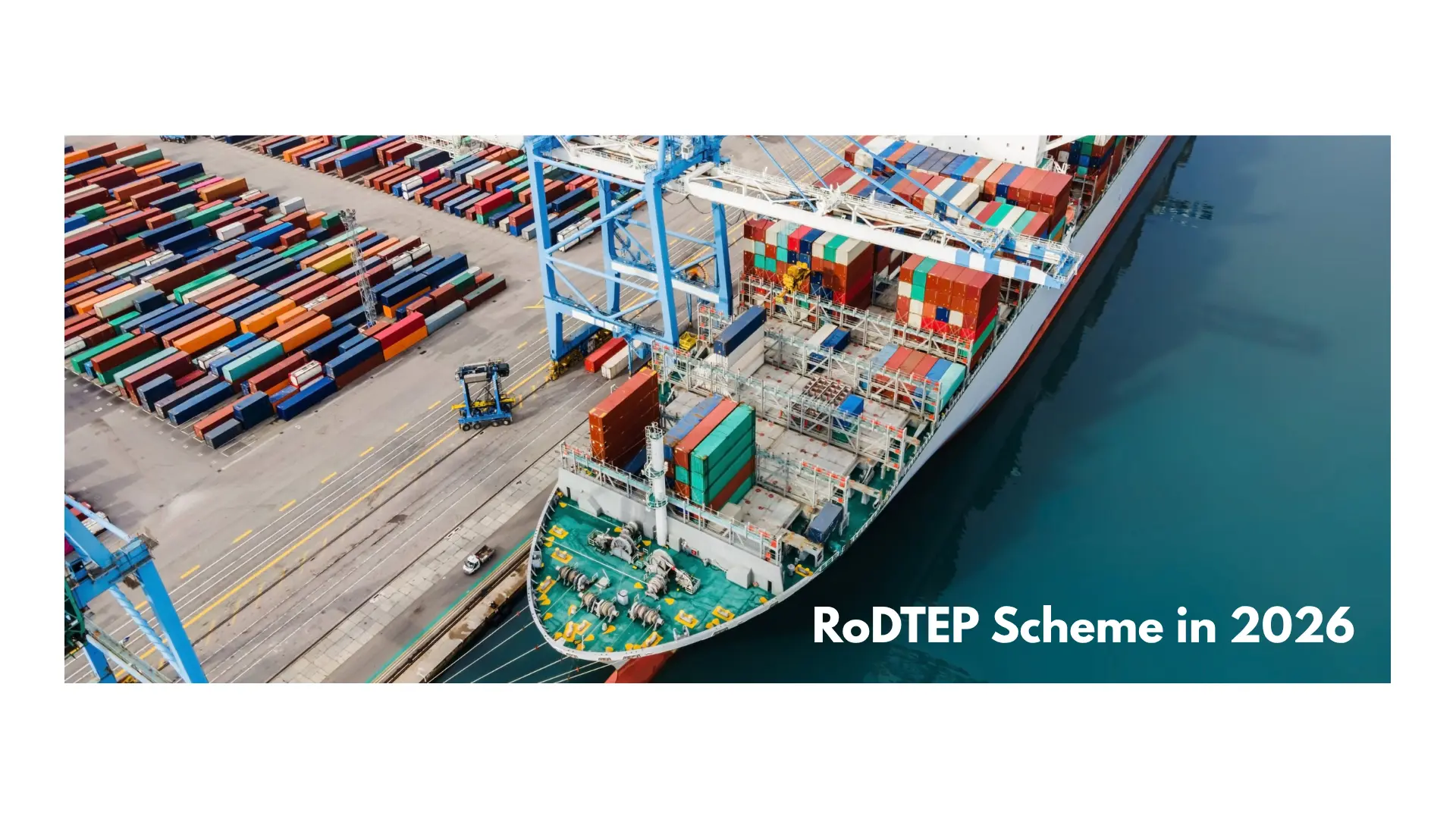
RoDTEP Scheme in 2026: How to Calculate and Claim Your Export Benefits
If you export goods from India, the RoDTEP scheme is one of the few policy levers that directly protects your margins — by refunding taxes that are otherwise silently absorbed into your cost structure. With a critical mid-year policy reversal already playing out in 2026 and a significantly reduced budget allocation, there is more at stake this year than in previous cycles. This guide covers what changed, how to calculate your entitlement accurately, and how to claim without losing money on the table.
CRITICAL UPDATE — APRIL 2026: The government temporarily cut RoDTEP payouts to 50% of notified rates in February 2026. Full rates were restored on March 23, 2026 via DGFT Notification No. 66/2025-26. The scheme is extended to September 30, 2026 via Notification No. 74/2025-26. The FY2026-27 budget allocation is ₹10,000 crore — down sharply from ₹18,233 crore. File promptly.
What is RoDTEP — and why it matters more than most exporters realise
RoDTEP stands for Remission of Duties and Taxes on Exported Products. It was introduced on January 1, 2021 to replace the MEIS scheme, which the WTO had flagged as a prohibited export subsidy. Unlike MEIS, RoDTEP does not add a top-up incentive — it remits only taxes and duties that are genuinely embedded in the cost of production but not refunded through any other mechanism.
These include central and state-level levies such as electricity duty, fuel taxes (non-creditable), mandi tax, stamp duty on export documents, and other residual embedded costs that escape the GST and Customs Duty Drawback net. The principle is straightforward: exports should be zero-rated for all domestic taxes, not just those covered by GST.
Benefits are issued as transferable electronic scrips (e-Scrips) credited to the exporter’s ledger on the ICEGATE portal. These can be used to pay Basic Customs Duty on imports or sold to other importers at near face value.
| Metric | Status / Value |
|---|---|
| Scheme valid until | Sep 30, 2026 |
| FY2026-27 budget | ₹10,000 Cr |
| Rate range (FOB) | 0.01% – 4.3% |
| Payout status | 100% restored |
What changed in 2026 — the three updates every exporter must track
1. The 50% cut and its reversal
In February 2026, the government restricted RoDTEP disbursements to 50% of notified rates, citing budgetary constraints. For many exporters, this was a significant cash-flow shock mid-quarter. Following representations from export councils and escalating maritime logistics costs driven by West Asia disruptions, the DGFT issued Notification No. 66/2025-26 on March 23, 2026, restoring payouts to 100% of notified rates and value caps.
If you have shipping bills processed during the restriction window, verify your ICEGATE ledger to confirm that the credits were revised upward post-restoration. Some accounts may need manual reconciliation.
2. Scheme extended to September 30, 2026
Via Notification No. 74/2025-26, the government extended RoDTEP through September 30, 2026. The scheme had previously been set to end March 31, 2026. This six-month extension provides policy continuity for exporters in the near term, though a longer-term renewal will need to be watched through mid-2026.
3. Budget allocation cut by 45%
The Union Budget for FY2026-27 allocated ₹10,000 crore to RoDTEP — down from ₹18,233 crore in the previous year. This is the most structurally important change for exporters. A compressed budget means claims may be processed on a first-come, first-served or pro-rata basis if total filings exceed available funds. Delay in generating and lodging scrips increases your risk of late or partial settlement.
PRACTICAL IMPLICATION: Do not let scrolls sit unprocessed in your ICEGATE ledger. Convert them to e-Scrips as soon as they appear. With a 45% budget cut, early filers are better protected than those who batch-process at quarter end.
Eligibility: who qualifies and who does not
| Category | Status | Basis |
|---|---|---|
| Manufacturer and merchant exporters | Eligible | Appendix 4R, DGFT |
| EOU and Advance Authorisation holders | Conditional | Eligible from June 2025 under Appendix 4RE |
| SEZ units | Excluded | Operating under a different duty-free framework |
| E-commerce exports | Eligible | Covered under notified HS codes |
| Export of services | Not applicable | Goods exports only |
| Deemed exports / supply to SEZ | Excluded | Physical export required |
| Exports to Nepal/Bhutan (INR payment) | Excluded | Eligible only against convertible forex |
How to calculate your RoDTEP benefit
The benefit is a percentage of the FOB value of your shipment, subject to a per-unit value cap where prescribed. Rates range from 0.01% to 4.3% depending on your 8-digit ITC-HS code. Always verify your rate in Appendix 4R (general exporters) or Appendix 4RE (AA/EOU) on the DGFT website before filing.
Core formula
RoDTEP Benefit (₹) = FOB Value (₹) × Notified Rate (%)
Subject to: Benefit ≤ Value Cap per unit (where prescribed)
Worked example
A textile exporter ships readymade garments (ITC-HS 6205) with a notified RoDTEP rate of 2% and a value cap of ₹150 per piece.
| Parameter | Scenario A (no cap binding) | Scenario B (cap binding) |
|---|---|---|
| FOB value | ₹5,00,000 | ₹5,00,000 |
| Quantity | 500 pieces | 500 pieces |
| Rate-based benefit (2%) | ₹10,000 | ₹10,000 |
| Cap-based ceiling (500 × ₹150) | ₹75,000 (not binding) | ₹75,000 (not binding) |
| Admissible benefit | ₹10,000 | ₹10,000 |
WHEN THE CAP BECOMES BINDING: Value caps most often bind when FOB value is unusually low relative to unit count — for example, bulk agricultural commodities at low per-unit prices. For high-value manufactured goods, the rate-based calculation is typically the lower (binding) figure.
Step-by-step: how to claim RoDTEP on ICEGATE
Step 1 — Declare intent on the shipping bill
While filing the Shipping Bill on ICEGATE, mark “YES” in the RoDTEP declaration field for each item line. This step is irreversible — a missed declaration cannot be added retrospectively. It is the single most common reason exporters forfeit valid benefits.
Step 2 — File the Export General Manifest (EGM)
Once goods are loaded and the shipping line files the EGM, the shipping bill moves to “EGM filed” status. This triggers the customs processing queue for RoDTEP.
Step 3 — Scroll generation by ICEGATE
The system automatically calculates the eligible benefit and compiles it into a “Scroll” — a batch-level statement of admissible RoDTEP credits against your IEC. Processing typically takes 3–7 working days post-EGM. Monitor your ICEGATE dashboard for scroll availability.
Step 4 — Activate your Electronic Credit Ledger (ECL)
Log in to ICEGATE using your Class-3 Digital Signature Certificate. Navigate to Services → RoDTEP and ensure your ECL account is active and linked to your IEC. New exporters must create this account before scrip generation is possible.
Step 5 — Generate e-Scrips from the scroll
Within the ECL, select the processed scrolls and convert them into e-Scrips. Each scrip carries a unique ID and face value. Scrips have a validity of one year from generation — lapsed scrips cannot be revalidated.
Step 6 — Utilise or transfer the e-Scrip
Use scrips to offset Basic Customs Duty on your import Bills of Entry, or transfer them to another IEC holder via ICEGATE’s transfer module. Market transfer prices typically range between 98–99.5% of face value.
Documents you need to keep ready
- Shipping Bill (with RoDTEP declaration confirmed)
- Export General Manifest (EGM) acknowledgement
- Commercial invoice and packing list
- eBRC — Electronic Bank Realisation Certificate
- RCMC — Registration-cum-Membership Certificate (if applicable)
- Class-3 Digital Signature Certificate (DSC) for ICEGATE login
- IEC (Import Export Code) linked to GST and PAN
Where exporters lose money — and how to avoid it
| Mistake | Impact | Fix |
|---|---|---|
| Missing RoDTEP declaration on shipping bill | Total loss of benefit for that consignment | Embed declaration in SOP; train CHA |
| Wrong 8-digit ITC-HS code | Wrong rate applied or ineligibility flagged | Verify against Appendix 4R before filing |
| Claiming under AA and RoDTEP simultaneously | Compliance violation; recovery demand | Segregate AA shipments; use Appendix 4RE |
| Not converting scrolls to e-Scrips promptly | Scrip lapses after one year; cash loss | Set a monthly ledger reconciliation schedule |
| Ignoring post-restoration credit adjustments | Under-credited ledger after Feb–Mar 2026 cut | Reconcile all scrolls processed Feb–Mar 2026 |
Frequently Asked Questions
1. Can I claim both RoDTEP and Duty Drawback on the same shipment?
+
Yes, in most cases. Drawback covers customs and central excise duties on inputs; RoDTEP covers other unrebated central and state levies. However, there must be no overlap — if a specific tax is already reimbursed under Drawback, it cannot also be claimed under RoDTEP. Verify the breakdown of each scheme’s coverage for your HS code before claiming both.
2. The scheme ends September 30, 2026. What happens to my pending scrips after that?
+
The extension deadline applies to eligible export transactions, not to scrip utilisation. Scrips already generated remain valid for one year from their generation date. However, keep a close watch on further DGFT notifications for post-September policy announcements — the scheme is likely to be reviewed or renewed.
3. My company exports under Advance Authorisation. Are we now eligible?
+
Yes, conditionally. AA exporters were brought under RoDTEP coverage from June 2025 under a separate rate schedule — Appendix 4RE. The rates differ from the standard Appendix 4R schedule and are generally calibrated to exclude taxes already remitted through the AA mechanism.
4. How do I sell my RoDTEP scrips if I have no import duty liability?
+
Log in to ICEGATE, navigate to the RoDTEP module, and initiate a scrip transfer by entering the buyer’s IEC. The buyer uses the scrip to pay BCD on their import Bills of Entry. Market prices for scrips typically range between 98–99.5% of face value, depending on demand and buyer profiles.
5. What should I do if my ledger was not updated after the March 2026 rate restoration?
+
Check the status of shipping bills processed during February–March 2026. If credits still reflect the 50% rate, raise a grievance ticket on ICEGATE or contact your jurisdictional Customs Commissionerate with the relevant scroll details and DGFT Notification No. 66/2025-26 as reference.
6. Is there a minimum export value to be eligible for RoDTEP?
+
No. There is no minimum FOB value or turnover threshold. Any shipment that meets the product eligibility criteria (notified ITC-HS code) and includes a valid RoDTEP declaration on the shipping bill qualifies — regardless of size.
SEO & Delivery Additions
Internal Linking Suggestions
- → “Duty Drawback vs RoDTEP: which scheme covers what” (comparison article)
- → “How to classify your product under ITC-HS codes correctly” (HS classification guide)
- → “ICEGATE portal: a complete guide for first-time exporters” (operational how-to)
- → “India export incentive schemes in 2026: a full landscape” (pillar page)
- → “Advance Authorisation scheme explained: eligibility and compliance” (AA deep-dive)
Image Ideas + SEO Alt Text
- Image 1: Flowchart of RoDTEP claim process (shipping bill → EGM → scroll → e-Scrip → utilisation) — Alt: “RoDTEP claim process flowchart 2026 ICEGATE steps”
- Image 2: Comparison table visual — RoDTEP vs Duty Drawback vs IGST refund — Alt: “India export duty refund schemes comparison 2026”
- Image 3: Screenshot-style ICEGATE ledger mockup showing scroll and e-Scrip generation — Alt: “ICEGATE RoDTEP ledger e-scrip generation screenshot”
- Image 4: India export value chart with RoDTEP benefit callout — Alt: “India merchandise exports 2026 RoDTEP benefit illustration”
External Authority References
- DGFT Notification No. 66/2025-26 — restoration of full RoDTEP rates (March 23, 2026)
- DGFT Notification No. 74/2025-26 — scheme extension to September 30, 2026
- DGFT Appendix 4R — notified RoDTEP rates and value caps (dgft.gov.in)
- DGFT Appendix 4RE — rates for AA/EOU exporters (dgft.gov.in)
- CBIC Circular on RoDTEP operational guidelines — icegate.gov.in
- Union Budget 2026-27 — Expenditure Budget, Demand No. for Commerce Ministry (indiabudget.gov.in)
- WTO Agreement on Subsidies and Countervailing Measures — Article 3 (wto.org)
Is your RoDTEP strategy optimised for 2026?
With a 45% budget cut and a scheme window closing September 30, exporters who act early and file accurately will capture the full benefit. Our trade and customs advisory team helps Indian exporters audit their HS classifications, reconcile ICEGATE ledgers, and structure claims to maximise recovery.
Request an export advisory consultation ↗