
Published: 3 Feb 2026
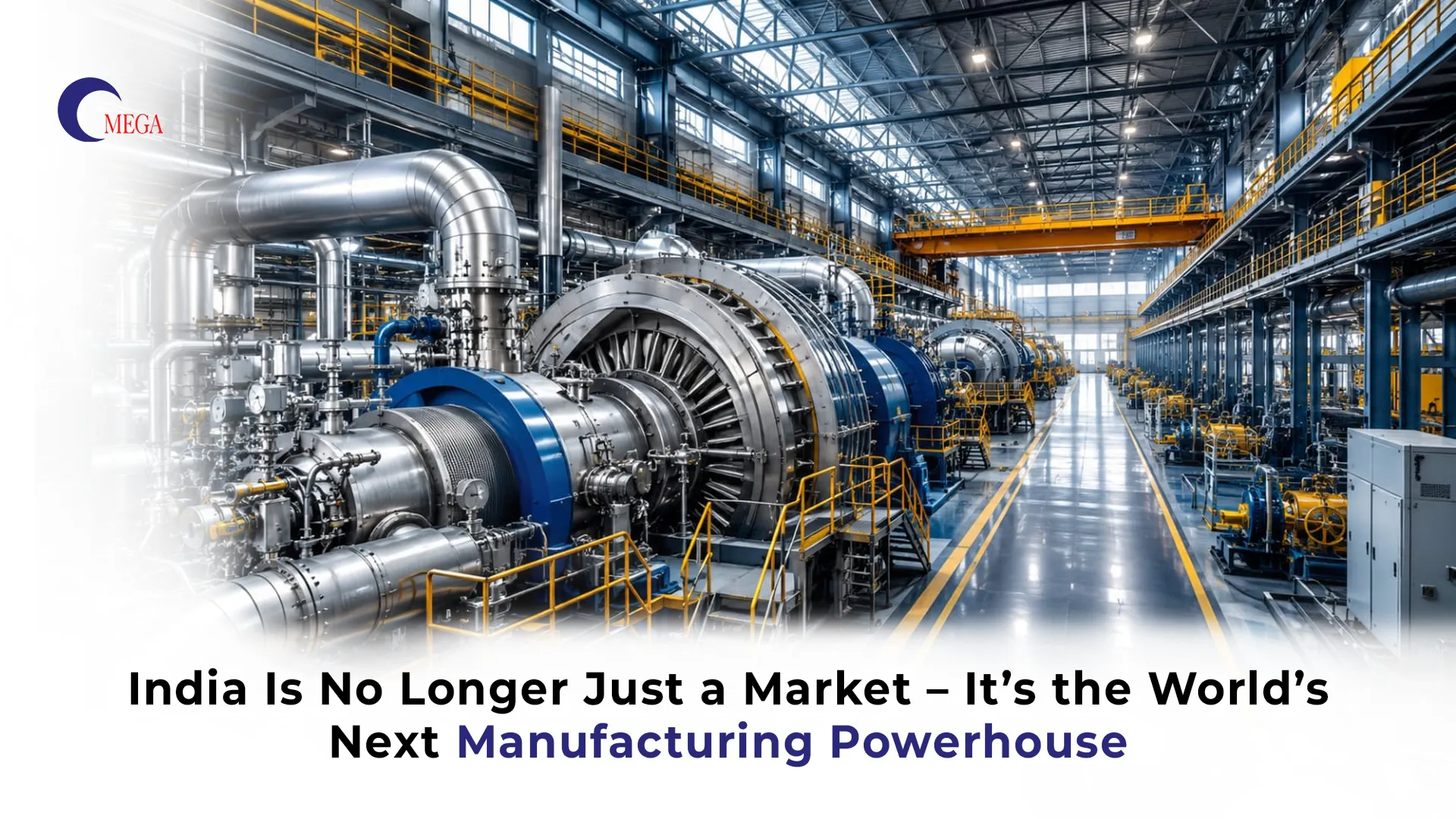
India Is No Longer Just a Market – It’s the World’s Next Manufacturing Powerhouse
Omega QMS Compliance Insights
Omega QMS
For over 25 years, Omega QMS Private Limited has been deeply engaged in India’s regulatory ecosystem, with a strong focus on technical regulations, conformity assessment, and Quality Control Orders (QCOs). These have remained our core strengths for more than two decades.
However, over the last two to three years, our role has expanded significantly. We are now actively advising Indian and global corporations on a wide range of matters including international trade, indirect taxes, customs facilitation, policy advocacy, and strategic government interface wherever the business environment demands it.
India’s Moment on the Global Manufacturing Map
India has now reached a pivotal stage in its economic journey. The message to global corporations is clear:
this is the right time to manufacture in India.
India offers an unmatched combination of:
- Abundant skilled and semi-skilled manpower
- A rapidly evolving industrial ecosystem
- Strong policy push for manufacturing and exports
- A vast and growing domestic market
With multiple Free Trade Agreements (FTAs) either concluded or under active negotiation—with regions and countries such as the EU, UAE, Australia, New Zealand, Oman, and others—India is positioning itself as a preferred global manufacturing and export base.
Further strengthening this opportunity is the recent reduction in US tariffs, now among the lowest in Asia (around 18%), opening a significant window for US- and Europe-based manufacturers to:
- Establish manufacturing footprints in India
- Serve the Indian market efficiently
- Export competitively to global destinations
India: Not Just a Market, but a 150-Crore Opportunity
India is often described as a market—but that description falls short.
India is a market of nearly 150 crore people, powered by a young, aspirational population, increasingly integrated with global value chains. Indian industry is no longer just meeting domestic demand; it is addressing global needs and solving global supply-chain challenges.
Today, India stands ready to become:
- A manufacturing hub
- An innovation partner
- A reliable export base for the world
How Omega QMS Supports Global Investors
At Omega QMS, we position ourselves as an end-to-end strategic partner for companies looking to invest in India, manufacture in India, sell in India, and export globally.
Our services include:
- Facilitation of setting up manufacturing units in India
- Advisory on central and state government policies & incentives
- Guidance on subsidies, schemes, and fiscal support
- Support in trade advisory, customs, and indirect tax matters
- Policy advocacy and government representation where required
- Assistance with market research and entry strategy
Looking Ahead
India’s growth story is accelerating—and manufacturing will be at its core.
We strongly believe that global corporations who align early with India’s manufacturing ecosystem will be the biggest beneficiaries of this transformation. At Omega QMS, we look forward to collaborating with forward-looking organizations that want to Make in India, Sell in India, and Export to the World.
India is ready. The opportunity is real. The time is now.
FAQs:
1. Why is India becoming a global manufacturing powerhouse?
India is emerging as a manufacturing powerhouse due to policy reforms, production-linked incentives, improving infrastructure, a large skilled workforce, and supply chain diversification away from single-country dependence.
2. How do government initiatives support manufacturing in India?
Initiatives such as PLI schemes, Make in India, and ease-of-doing-business reforms provide financial incentives, regulatory simplification, and infrastructure support to manufacturers.
3. Which sectors are driving India’s manufacturing growth?
Key sectors include electronics, pharmaceuticals, automotive, chemicals, renewable energy, and consumer goods manufacturing.
4. Why are global companies shifting manufacturing to India?
Global companies are attracted to India due to cost competitiveness, market scale, geopolitical stability, supportive government policies, and access to a large domestic and export market.
5. How does India compare with China as a manufacturing destination?
While China remains a major manufacturing hub, India offers an alternative with growing infrastructure, policy incentives, and long-term scalability, especially for companies diversifying supply chains.
6. What challenges does India face in becoming a manufacturing hub?
Challenges include land acquisition, logistics costs, regulatory complexity, and skill gaps, though continuous reforms are addressing these issues.
7. How can foreign manufacturers enter India’s manufacturing ecosystem?
Foreign manufacturers can enter India through market entry planning, local partnerships, government facilitation mechanisms, and compliance with regulatory and investment frameworks.
Planning to manufacture or expand your operations in India?
Connect with us to navigate India’s regulatory landscape, investment frameworks, and compliance requirements so you can enter, scale, and operate in India with confidence.