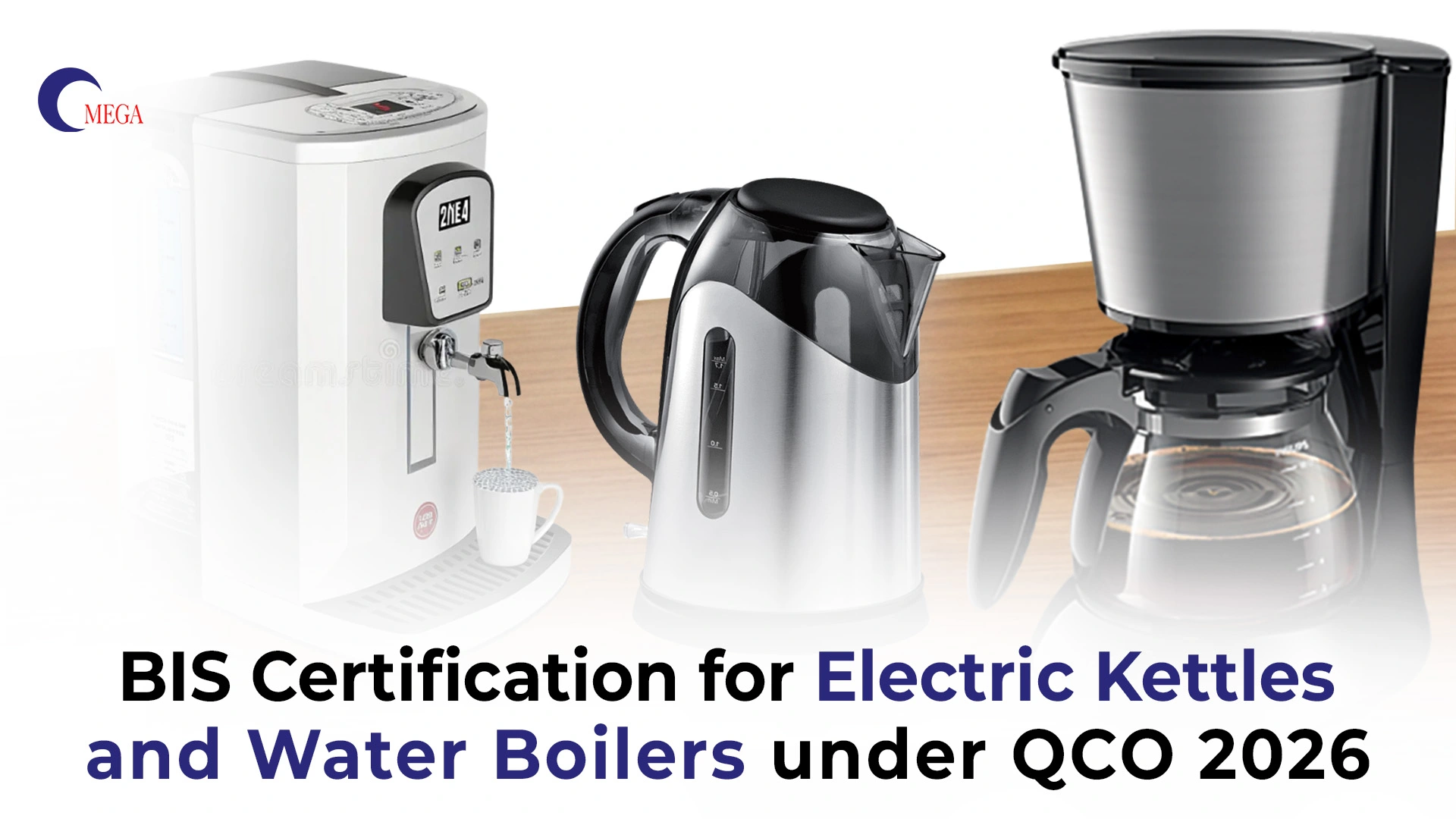
BIS Certification for Electric Kettles and Water Boilers under QCO 2026
Electric kettles and water boilers are among the most commonly used kitchen appliances in India. Under the Safety of Household, Commercial and Similar Electrical Appliances (Quality Control) Order, 2026 — commonly referred to as QCO 2026 — BIS certification is mandatory for these appliances before they can be sold or imported in India.
Covered Products
- Electric Water Boilers
- Appliances for Heating Liquids
- Electric Coffee Makers (related heating application)
Applicable Standard
IS 302 (Part 1): 2024 — Household and Similar Electrical Appliances — Safety: Part 1 General Requirements (technically equivalent to IEC 60335-1: 2020).
Key Compliance Requirements
- BIS licence under Scheme-I mandatory before any sale or import
- Product testing at a BIS-recognised laboratory against IS 302 (Part 1): 2024
- Factory inspection and audit by BIS
- ISI marking required on every certified unit
- Ongoing surveillance audits to maintain licence validity
Important Note on Product Classification
Electric kettles fall under the category of “Appliances for Heating Liquids” or “Electric Water Boilers” depending on their design and intended use. It is important to correctly identify which QCO line item applies to your specific product before submitting a BIS application. Incorrect classification can lead to test scope mismatches and delays in licence grant.
Why This Category Matters
Electric kettles and water boilers are high-volume, low-cost imports widely traded across e-commerce platforms and retail channels in India. This makes them a high-priority category for BIS enforcement. Uncertified products found in the market or at customs after the implementation date are liable to seizure and penalties under the BIS Act, 2016.
Implementation Timeline
| Enterprise Type | Compliance Date |
|---|---|
| General (other than micro and small) | 1st October 2026 |
| Small Enterprises | 1st January 2027 |
| Micro Enterprises | 1st April 2027 |
Key Exemptions
- Export manufacturing: Goods manufactured domestically solely for export are exempt.
- R&D imports: Up to 200 units per year may be imported for R&D without BIS certification, provided they are not sold commercially. Year-wise records must be maintained.
- Existing stock: Declared stock held by a BIS-certified manufacturer (or one who has applied) may be sold for up to six months from the implementation date, subject to a declaration to BIS.
Conclusion
Electric kettles and water boilers are a straightforward compliance case under QCO 2026. The products are clearly listed, the standard is well-established, and the deadline is firm. Manufacturers and importers should initiate BIS applications without delay to avoid disruption after October 2026.
How Omega QMS Supports BIS Certification for Electric Kettles and Water Boilers
Omega QMS Pvt. Ltd. assists Indian manufacturers, foreign manufacturers, and importers in obtaining BIS certification for electric kettles, water boilers, and liquid heating appliances under the Electrical Appliances QCO 2026.
Our services cover:
- Product-level QCO scope assessment and correct line item classification
- Exemption eligibility assessment for R&D imports and export manufacturing
- BIS certification strategy and documentation for Indian and foreign manufacturers
- Coordination with BIS-recognised testing laboratories for IS 302 compliance
- Authorised Indian Representative (AIR) services for foreign manufacturers
- Customs documentation support for compliant import clearance
The QCO Is Notified — Uncertainty Has a Cost
The Electrical Appliances QCO introduces strict regulatory requirements for electric kettles and water boilers. Companies that have not yet conducted a formal applicability assessment are operating with regulatory uncertainty that carries real commercial and legal risk.
Omega QMS Pvt. Ltd.
📞 +91-11-41413939 (100 Lines)
📍 909, Hemkunt House, Rajendra Place, New Delhi – 110008
Contact our regulatory team for a product-level applicability assessment and a clear view of your BIS certification requirements under the Electrical Appliances QCO.